Is Your E-Commerce Website Ready for AI Search?
For years, e-commerce search followed a familiar path. A customer searched for a product, clicked through a list of results, visited several websites, compared options, and eventually made a purchase.
AI is beginning to change that journey.
Instead of searching for a specific product name, shoppers can now describe what they are looking for in much greater detail. Someone could ask for a premium golf polo designed for warm weather, a lightweight travel bag within a certain price range, or a gift for a golfer who already owns the basics.
The search platform can then help narrow the options before the customer ever reaches an individual product page.
For e-commerce businesses, this creates a new challenge. It is no longer enough for your website to look good once someone arrives. Your products also need to be clearly understood before that visit happens.
That puts website structure, product information, technical SEO, content, brand authority, and e-commerce website design and development much closer together.
Quick Answer
E-commerce websites should begin preparing for AI-powered product discovery, but that does not mean abandoning traditional SEO or redesigning an entire store around ChatGPT.
The strongest approach is to make products easier for both people and search technologies to understand. Product names, descriptions, categories, attributes, pricing, availability, imagery, supporting content, and technical information all contribute to that process.
At the same time, discovery is only part of the equation. If AI search introduces a customer to your product, the website still needs to convince that person to buy.
That is why AI search optimization for e-commerce cannot be treated as an isolated SEO tactic. It needs to connect with the entire shopping experience.
E-Commerce Search Is Becoming More Conversational
Traditional product search often depended heavily on short keywords. A shopper might search for “men’s golf polo.”
AI-powered search makes it much easier to express intent in a more natural way. The same shopper might instead look for a premium golf polo with a modern fit, technical materials, subtle branding, and a style that works both on and off the course.
That additional context changes what an e-commerce website needs to communicate.
A product page that only provides a product name, a few images, and a short generic description may not give search technologies enough information to confidently understand where that product fits. The more specific the customer’s request becomes, the more important accurate product information becomes.
Material, fit, use case, dimensions, features, compatibility, style, audience, availability, and other meaningful attributes can help define why one product is different from another.
This is useful for AI search, but it is also simply better e-commerce.
Product Pages Need to Do More Than Rank

For years, e-commerce SEO strategies often focused heavily on getting category and product pages to rank for valuable keywords.
That still matters.
But product pages now have another job. They need to provide enough useful context to help search platforms understand the product itself.
Consider two stores selling a similar premium golf bag. One product page provides the product name, price, two photos, and a short paragraph. The other clearly explains the materials, storage capacity, weight, design features, intended use, available colors, product dimensions, and what separates the bag from other options.
The second page gives customers more information to make a decision. It also creates a much clearer description of the product for search technologies.
Good e-commerce content should answer the questions someone would naturally ask before purchasing instead of relying on a keyword-filled paragraph designed primarily for rankings.
What McLaren Golf Shows About Modern E-Commerce

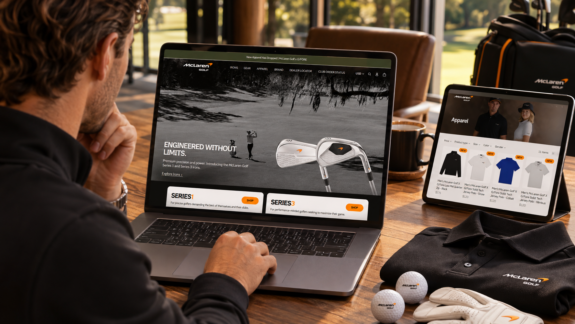
A useful example comes from Lounge Lizard’s work with McLaren Golf.
McLaren entered the golf category with more than just a new collection of products. It brought decades of brand equity associated with performance, engineering, competition, technology, and premium design into an entirely new market.
The challenge was not simply to create an online store.
Lounge Lizard needed to translate an established global identity into a premium e-commerce experience that made sense for golfers while remaining unmistakably connected to the larger McLaren brand.
The project included digital strategy, UX/UI design, e-commerce web design, development, and quality assurance. The finished experience used visual storytelling, refined interactions, disciplined interface design, and strong brand consistency to create what Lounge Lizard describes as a digital flagship for the new category.
That distinction matters.
E-commerce websites are not simply databases of products. They are environments where product information, brand positioning, design, navigation, and conversion strategy have to work together.
Why That Approach Matters for AI Search
The McLaren Golf project was not built as an experiment in chasing an AI search trend. That is exactly why it provides a useful example.
The fundamentals of the project reflect many of the same areas e-commerce brands now need to think about as product discovery becomes more intelligent.
The brand had to be clearly represented. The new golf category needed its own identity while maintaining its relationship with McLaren. Products needed to live inside a structured shopping experience. Visual storytelling needed to communicate quality and performance. The interface needed to remain usable despite the premium design direction.
AI search does not eliminate any of those requirements.
It makes the underlying information even more important.
An AI platform may help someone discover a product, but the product still exists within a larger brand story. Customers still want to understand what makes the product different, whether they trust the manufacturer, what they are actually purchasing, and whether the experience feels credible.
For premium brands in particular, discoverability and brand experience cannot be separated. This is also why AI Search & Creative strategy needs to work alongside the website rather than exist as a completely separate marketing effort.
Your Product Catalog Needs a Clear Structure

One of the easiest ways to make an e-commerce website harder to understand is to let the catalog become disorganized.
Categories overlap. Product naming becomes inconsistent. Filters use different terminology. Similar products describe the same attribute in several different ways.
Customers feel that confusion, and search technologies can experience the same problem.
A well-planned e-commerce structure should create clear relationships between categories, collections, products, and supporting content. A shopper looking for golf apparel should be able to move naturally into polos, outerwear, accessories, or other relevant collections without guessing where something belongs.
The same principle applies to product attributes.
If one product describes a material as “performance fabric,” another calls it “technical fabric,” and a third uses only the manufacturer’s internal material name, the catalog may become harder to interpret consistently.
This is where e-commerce strategy needs to connect with development and content management. A store should be structured in a way that allows teams to manage product information consistently as the catalog grows.
Structured Product Information Is Becoming More Important
AI search places additional value on information that can be clearly interpreted.
That includes the visible content customers read, but it also includes the structured information supporting the e-commerce website.
Depending on the store, important product information may include:
- Product name and description • Brand • Price • Availability • SKU or product identifiers • Images • Variants • Size and dimensions • Materials • Reviews • Category information
That information needs to remain accurate.
There is little value in getting a product surfaced during the discovery process if the listed price is outdated, the selected variation is unavailable, or the product details are incomplete.
For e-commerce brands, catalog management is becoming part of search strategy. Product data should not be treated as something that only matters inside the store’s backend.
AI Search Does Not Mean Product Descriptions Should Sound Like AI
One potential mistake is assuming businesses now need to rewrite every product description specifically for a language model.
They do not.
Product content still needs to be written for customers. The difference is that generic descriptions are becoming less useful.
If every retailer describes a product as “premium,” “innovative,” “high quality,” and “designed for performance,” those phrases provide very little meaningful information.
Strong product content should explain what makes those claims true.
What material is being used? What problem does the feature solve? Who is the product designed for? How does it fit? What makes it different? When would someone choose this product over another option?
Those details help the customer understand the product while naturally providing more context for search.
Brand Authority Still Influences the Buying Decision

AI-powered shopping does not eliminate the value of a strong brand. If anything, it can make brand recognition more valuable.
A recommendation is only one part of a buying decision. Customers may still research the company, read reviews, explore the website, look at social media, compare competitors, and evaluate whether they trust the retailer before purchasing.
This is especially important for premium e-commerce.
McLaren Golf could not be presented like an interchangeable online golf store. The digital experience needed to communicate the performance, precision, and exclusivity customers already associate with McLaren while adapting that identity to a new category.
Lounge Lizard’s approach focused heavily on that connection. The website needed to feel distinct enough for golf while remaining authentic to McLaren’s larger identity.
That same thinking applies to AI-driven discovery. Your products need to be understandable, but your brand also needs to be recognizable.
Search Visibility and Conversion Cannot Be Separated
There is a tendency to treat SEO as the work that gets someone onto the website and web design as the work that takes over once they arrive.
That separation is becoming less useful.
AI search, traditional SEO, product feeds, website architecture, content, UX, and conversion optimization increasingly influence different parts of the same customer journey.
Imagine an AI platform successfully introduces a shopper to your product. The shopper clicks through, but the website loads slowly, the navigation is confusing, the product imagery is weak, important information is missing, or the checkout process creates unnecessary friction.
The visibility worked.
The e-commerce experience failed.
That is why brands need to look at AI search readiness as part of a larger e-commerce strategy instead of another technical box for the SEO team to check. Strong custom web design still plays a direct role in whether the attention generated by search actually turns into a sale.
The Lounge Lizard Approach: Build the Experience Around the Business
Strong e-commerce work begins before the product pages are designed. The first question should not be, “What theme should we use?”
It should be, “How does this business actually sell?”
That requires understanding the brand, the customer, the product catalog, the purchasing journey, the content requirements, and the technical systems supporting the store.
From there, website structure, UX, design, development, search requirements, and conversion strategy can work toward the same goal.
That process was particularly important for McLaren Golf because the project needed to solve two problems at once. It had to introduce a completely new product category while protecting the identity of one of the world’s most recognizable performance brands.
The result was not simply a set of attractive product pages. It was an e-commerce platform built around the way the brand needed to enter and grow within a new market.
What Should E-Commerce Brands Focus on Now?
Businesses do not need to chase every new feature being released across AI platforms.
They should make sure the fundamentals of their e-commerce operation are strong enough to support new discovery channels as they develop.
That means reviewing whether product information is complete and consistent, whether the catalog has a logical structure, whether important content is crawlable, whether technical SEO is being maintained, and whether product pages clearly explain why someone should buy.
Brands should also evaluate what happens after discovery. Does the website communicate trust? Does the design support the value of the product? Can shoppers quickly compare options? Does the mobile experience work? Is checkout straightforward? Is the brand memorable?
Preparing for AI search should strengthen the e-commerce experience rather than distract from it.
AI Search Is Changing Discovery, Not the Fundamentals of E-Commerce
AI search is changing how products can enter the consideration process.
A customer may discover an item through ChatGPT, Google’s AI-powered shopping experiences, a traditional organic result, a marketplace, social media, or another channel entirely.
That makes it tempting to create separate strategies for every new platform. A better approach is to build a stronger foundation.
Clear product information can support search. A structured catalog can support search. Original product content can support search. Technical accessibility can support search. Strong brand positioning can support trust. Good UX can support conversion.
When those pieces work together, the website becomes better prepared for both the search environment that exists today and the new discovery experiences that continue to emerge.
Frequently Asked Questions
How does AI search affect e-commerce websites?
AI search allows shoppers to describe products and purchasing needs in more conversational and detailed ways. This makes clear product information, catalog structure, technical accessibility, and accurate data increasingly important for e-commerce brands.
Do e-commerce websites need to optimize specifically for ChatGPT?
E-commerce businesses should consider how easily their products can be understood by
AI-powered search platforms, but they should not abandon traditional SEO or customer-focused content. Many of the improvements that make products clearer for AI also create a better shopping experience for customers.
Are product descriptions important for AI search?
Yes. Product descriptions should provide meaningful details about the product rather than relying on generic marketing language. Materials, features, use cases, sizing, compatibility, and other relevant attributes can give customers and search technologies more useful context.
Does web design still matter if AI recommends the product first?
Absolutely. AI may help a shopper discover a product, but the website still needs to build trust and complete the sale. Product presentation, navigation, mobile usability, page performance, brand consistency, and checkout experience remain critical.
The Bottom Line
AI is changing product discovery, but successful e-commerce still depends on much more than being included in a recommendation.
Customers need accurate product information. They need to understand the brand. They need to trust the website. They need a clear path from discovery to purchase.
The strongest e-commerce experiences bring those requirements together.
Lounge Lizard’s work with McLaren Golf demonstrates that approach. The challenge was not simply building an online store. It was understanding the brand, translating its identity into a new category, creating the right shopping experience, developing the platform, and maintaining a high standard of quality throughout the process.
That type of foundation becomes even more valuable as AI plays a larger role in how consumers find and compare products.
At Lounge Lizard, our e-commerce services bring together digital strategy, UX/UI design, e-commerce web design, development, SEO/AEO, and conversion-focused thinking. Combined with our AI Search & Creative services, we help brands think about the full journey from how products are discovered to what happens after a customer reaches the store.
As AI search continues to influence e-commerce, the brands best positioned to succeed will be the ones that make their products easy to understand while giving customers a strong reason to choose them.