
Does Your Web Design Need to Be Optimized for ChatGPT and AI Search?
For years, businesses have designed websites around two primary audiences: users and search engines. A website needed to look professional, provide a strong user experience, rank in Google, and ultimately turn visitors into customers.
That is still true, but the way people search for information is changing. Potential customers are increasingly using ChatGPT and other AI-powered search experiences to research companies, compare services, understand products, and make decisions before they ever visit a website. Instead of searching a keyword, opening several tabs, and manually comparing websites, users can now ask a detailed question and get a summarized answer.
This changes your website’s role in the customer journey. Your site still needs to perform well for traditional search and users. Still, it also needs to clearly communicate enough information for AI-powered search systems to understand what your business does, what you specialize in, and when your company may be relevant.
The good news is that businesses do not need to rebuild their websites around AI. In most cases, the same principles that support strong web design, SEO, content, and user experience also create a better foundation for AI search visibility.
Quick Answer
Yes, businesses should consider AI search when designing and optimizing their websites, but that does not mean creating a separate AI-specific website. The priority is making your site easy to understand, easy to crawl, and useful to the people searching for your services.
Clear website structure, strong technical SEO, helpful content, accurate business information, original expertise, and a good user experience all make it easier for search engines and AI-driven platforms to understand your website. The goal is not to design for robots. It is to make your business and its expertise as clear as possible.
Why AI Search Changes the Role of Your Website
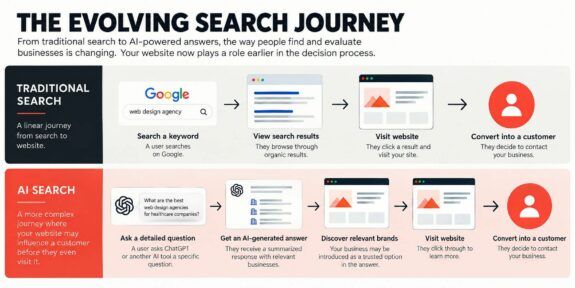
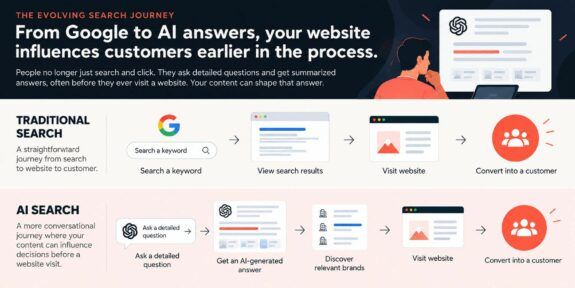
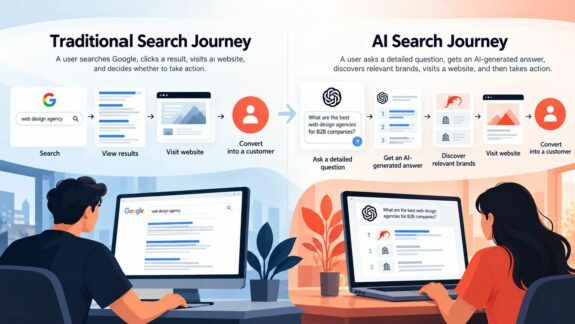
The traditional search journey remained relatively straightforward. Someone searched Google, clicked a result, visited a website, and decided whether to contact the business.
AI search adds another step before visiting a website. A potential customer might ask ChatGPT which agencies specialize in a certain industry, what they should look for in a provider, or which companies offer a particular service. The answer may summarize information from multiple sources and introduce the user to several businesses before they click on any individual website.
That means your website may influence a customer’s decision before they actually visit it. The content, structure, and information on your site can help search technologies understand what your company offers and how it fits into a particular search.
This does not make traditional web design less important. It expands what the website needs to accomplish.
Clear Website Structure Matters More
Website structure has always played an important role in both SEO and usability. As search becomes more conversational and AI-driven, clear structure becomes even more valuable because it helps define the relationships between your services, industries, expertise, and content.
If a company offers web design, web development, SEO, digital marketing, ecommerce development, and branding, those services shouldn’t all be buried on one general page. Each major service should have enough dedicated content to explain what the company offers, who it’s for, and how it relates to the rest of the business.
The same applies to industries, locations, case studies, and other important areas of the website. A company with extensive experience in financial services, healthcare, ecommerce, or professional services should make that expertise clear, rather than expecting visitors to piece it together from unrelated pages.
A strong website structure makes navigation easier for users while giving search technologies clearer insight about the business as a whole.
Your Content Needs to Be Clear, Not Just Creative
Creative messaging is an important part of web design, but it should not come at the expense of clarity. A homepage can look polished and still fail to explain what the company actually does clearly.
This often happens when websites rely too heavily on broad marketing language. Headlines such as “Building Digital Experiences That Inspire Growth” may support the brand, but they provide very little context on their own. A headline that clearly identifies the service, audience, or value proposition gives both users and search technologies a much stronger understanding of the page.
That does not mean every heading needs to sound like an SEO keyword. Businesses should still have personality and a distinct brand voice. The goal is to balance creative messaging with enough straightforward information that a visitor can quickly understand what the company offers.
Your services, products, locations, industries, experience, and differentiators should all be easy to identify. If a potential customer cannot figure out what your company does within a reasonable amount of time, the website is creating unnecessary friction.
AI Search Makes Useful Content More Important
Traditional SEO has always relied heavily on content, but AI search is changing the types of questions businesses need to consider.
Someone using Google might search for “NYC web design agency.” That same person might ask ChatGPT, “What should I look for when choosing a web design agency for a financial services company?” The underlying intent is similar, but the second query is much more detailed.
This means businesses should think beyond individual keywords and consider the questions customers actually ask during the buying process. What concerns come up during sales calls? What information do clients need before requesting a proposal? What helps someone compare your company with another option?
You can answer those questions naturally throughout the website. Service pages, blog articles, case studies, FAQs, industry pages, and educational resources can all provide the information potential customers are looking for.
The goal is not to create hundreds of pages targeting every possible variation of a question. Instead, build useful content around the areas where your business has genuine knowledge and experience.
Original Expertise Is Becoming More Valuable
AI has made it easier than ever to produce content, which also means the internet is becoming filled with more generic information. Businesses that repeat the same basic advice already available on hundreds of other websites may struggle to stand out.
Original expertise gives your content a stronger reason to exist.
A web design agency could publish another article explaining the benefits of responsive design, or it could publish an article explaining what the team learned after redesigning dozens of B2B websites. The second article offers something more valuable: real-world experience.
Businesses should look for opportunities to incorporate information such as:
• Case study results
• Internal data
• Expert commentary
• Real project experience
• Industry observations
• Common client problems
• Lessons learned
• Original research
This type of content can support traditional SEO and AI search while also helping potential customers understand why they should trust your company.
The stronger your firsthand knowledge is represented on the website, the less your content feels interchangeable with everyone else’s.
Technical SEO Still Matters
AI search may feel like an entirely new area of digital marketing, but many of the technical requirements behind visibility are familiar.
Search platforms still need to access your website. Important pages need to be crawlable, internal links should work properly, XML sitemaps should remain accurate, and canonical tags should be implemented correctly. Businesses should also make sure important pages aren’t accidentally blocked by noindex directives, firewall settings, bot protection, or other technical configurations.
JavaScript can also create issues when important information depends entirely on scripts to load. Modern websites can still use interactive and dynamic functionality, but essential content should remain accessible.
For businesses interested in appearing within ChatGPT search, it is also worth reviewing whether OpenAI’s search crawler is being unintentionally blocked. Search technology keeps progressing, but the basic principle remains the same: if a platform cannot access or understand your website, it is much less likely to surface that information.
Good Design Should Make Information Easier to Find
Modern websites frequently use tabs, accordions, sliders, animation, popups, carousels, and other interactive elements. These features can improve the experience when used strategically, but they can also make information harder to find when everything is hidden behind an interaction.
Important service information, company details, expertise, locations, and calls to action should be easy to access. Visitors should not have to click through several elements to understand what the company offers.
This is not simply an AI search consideration. It is a fundamental web design principle.
Strong design should help organize and communicate information. It should guide users through the page, create a clear visual hierarchy, and make the next step obvious. AI search gives businesses another reason to ensure design supports the content instead of competing with it.
Your Brand Needs to Be Consistent
AI-powered search systems may encounter information about your business across multiple pages and platforms. That makes consistency increasingly important.
Your company name, services, locations, leadership information, contact details, and areas of expertise should be represented accurately throughout the website. Your About page should reinforce the same business story as your homepage, and your service pages should use consistent terminology when describing what you offer.
This consistency helps users understand the business and creates a clearer overall picture of the company online. If one page describes your company as a web design agency while another presents it as primarily a marketing consultancy, the positioning becomes less clear.
Your website should serve as the central source of truth for your brand. The more accurately and consistently it communicates who you are, the easier it becomes for people and search technologies to understand what your company is associated with.
AI Search Does Not Replace User Experience
Getting mentioned in an AI-generated answer has limited value if someone eventually visits your website and has a poor experience.
The website still needs to perform its original job. It needs to create confidence, make the company easy to understand, and encourage the visitor to take action.
Businesses should continue focusing on the fundamentals of user experience, including page speed, mobile usability, navigation, accessibility, clear calls to action, readable content, simple forms, case studies, testimonials, and strong service pages.
AI search may change how someone discovers your business, but it does not change what they expect once they arrive. A potential customer coming from ChatGPT will still evaluate your website’s professionalism, usability, credibility, and quality before deciding.
Is AI Search Optimization Different From SEO?
There is growing discussion around terms such as Generative Engine Optimization, Answer Engine Optimization, GEO, AEO, and AI SEO. These terms reveal real changes in how people discover information, but businesses should be careful not to treat AI search optimization as completely separate from traditional SEO.
There’s significant overlap.
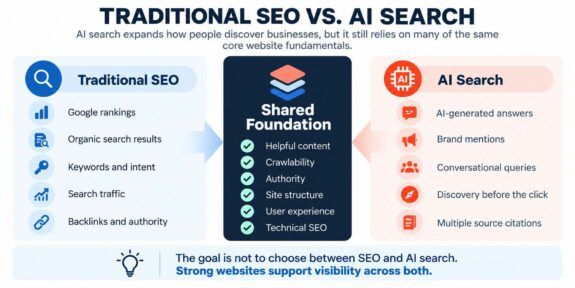
Strong SEO already depends on useful content, clear website structure, crawlability, authority, technical performance, and a good user experience. Those same principles also help make a website easier for AI-powered search platforms to understand.
The biggest difference is that visibility is expanding beyond the traditional search results page. A business may now be discovered through an AI-generated response, a traditional organic result, a local result, a video, or another search experience.
AI search should therefore be viewed as an expansion of search strategy, not a replacement for everything businesses already know about SEO.
Do You Need to Redesign Your Website for AI Search?
Most businesses don’t need a complete website redesign just because AI search is growing. What they do need is a realistic assessment of how well their current website communicates information.
A site may look modern but still have weak service pages, confusing navigation, thin content, outdated company information, or technical SEO issues. Those problems were already hurting the website before AI search became part of the conversation.
The better approach is to identify where the site lacks clarity or useful information and improve those areas. That could mean expanding important service pages, improving internal linking, strengthening case studies, updating technical SEO, or reorganizing content so that users can find information more easily.
These improvements can benefit traditional SEO, AI search visibility, conversion rates, and user experience at the same time.
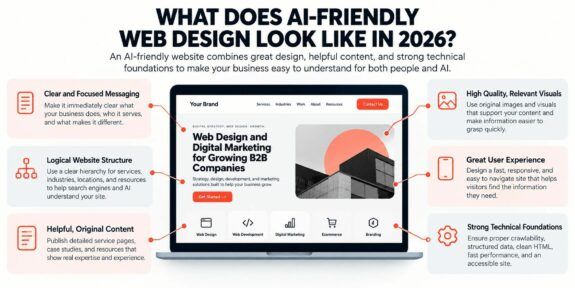
What Does AI-Friendly Web Design Look Like in 2026?
AI-friendly web design does not necessarily look different from traditional web design. The biggest difference is how the website is planned and how closely different disciplines work together.
Designers need to think about how information is organized. Developers have to ensure information is accessible and technically sound. SEO teams need to understand how pages connect, while content teams need to answer the questions customers actually care about.
The strongest websites bring those areas together. Great design attracts attention, clear content creates understanding, strong UX helps users take action, technical SEO improves discoverability, and original expertise cultivates trust.
That combination has always been valuable. AI search is simply making it more important.
Frequently Asked Questions
Does my website need to be optimized for ChatGPT?
Businesses should make sure their websites are clear, accessible, useful, and technically sound to stay visible as AI search grows. This does not require building a separate website specifically for ChatGPT.
Can ChatGPT find my website?
ChatGPT may discover public websites through its search. Businesses should make sure important pages are crawlable, and that relevant search crawlers are not unintentionally blocked.
Does AI search replace traditional SEO?
No. Traditional search still plays a major role in how customers discover businesses. AI search adds another discovery channel, so businesses should plan for visibility across both.
Do I need special AI schema?
There is no single schema type that guarantees AI search visibility. Still apply structured data where relevant as part of a broader technical SEO strategy.
Can better web design improve AI search visibility?
Yes. Clear architecture, useful content, accessible information, strong technical performance, and a solid website structure can all make a business easier for search technologies to understand.
The Bottom Line
Your website doesn’t need a complete redesign for ChatGPT, but it does need to be prepared for a search environment where customers may learn about your business before they ever visit your site.
That makes clarity, website structure, content quality, and technical accessibility increasingly important. Businesses should focus less on chasing every new AI optimization tactic and more on making sure their websites clearly explain what they do, demonstrate real expertise, answer useful questions, and provide a strong experience once someone arrives.
AI search does not replace the fundamentals of good web design and SEO. It makes those fundamentals more important.
At Lounge Lizard, we combine web design, development, SEO, content strategy, and conversion optimization to help businesses build websites around how customers actually search and make decisions. If you are unsure whether your website is prepared for ChatGPT and AI-powered search, contact Lounge Lizard to identify opportunities to improve your search visibility, user experience, and overall website performance.